
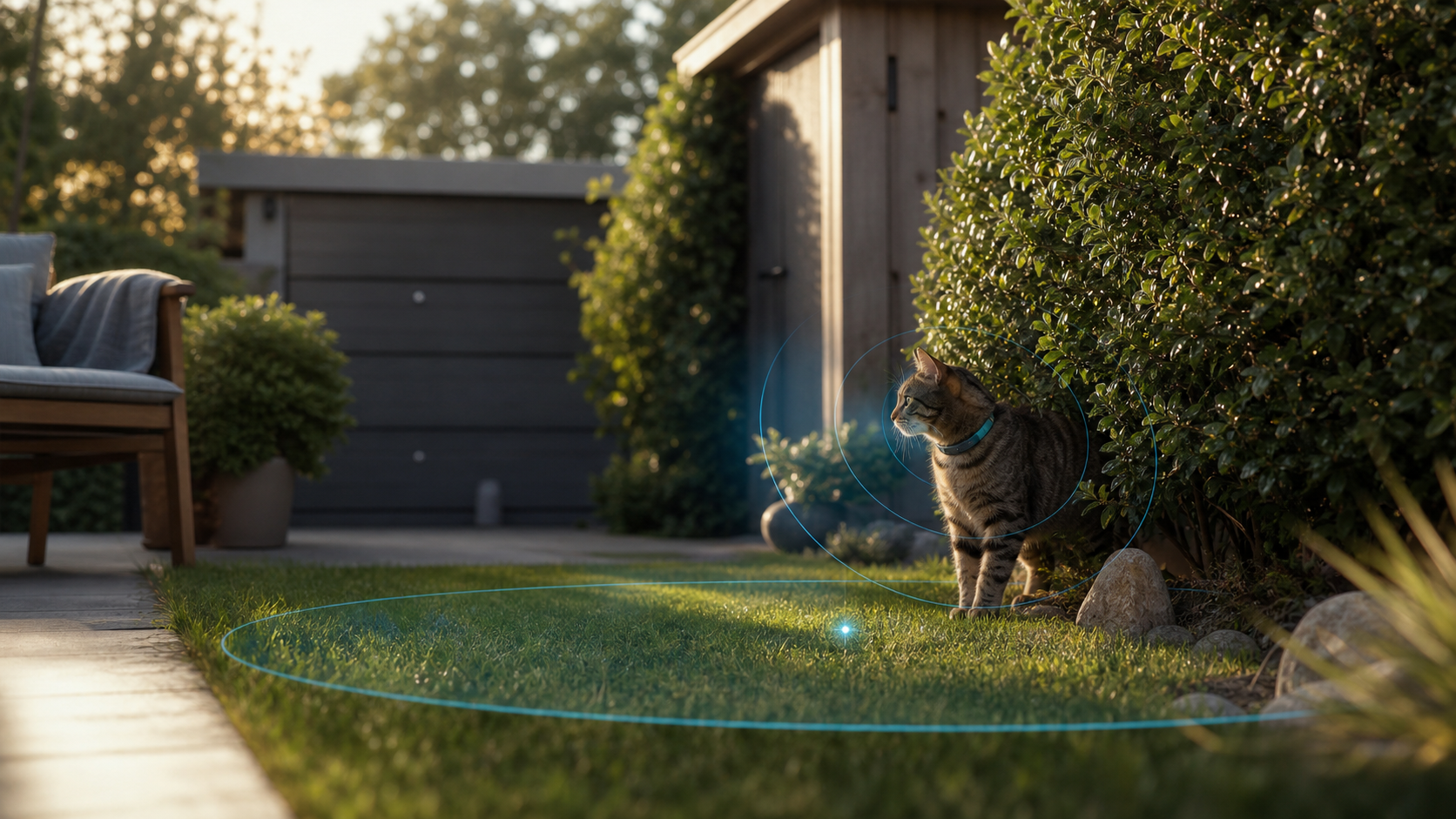
Most cat trackers promise one simple thing: location. For outdoor cats, that is valuable. But when a cat does not come home, the hard part often starts after you see the last point on the map.
The cat may be close. She may be hidden. She may be silent. She may be behind a shed door, under a deck, inside a garage or at the edge of a garden where GPS gives you a search area, not a clear answer.
That is why PetTracer is built less like a gadget and more like a search system: GPS helps you narrow the area, while radio near-search helps when your cat may be close but difficult to see.
1. Your cat is in a shed and does not make a sound
This is one of the most common situations cat owners underestimate. An outdoor cat can slip into a shed, garage, basement or garden building and stay completely quiet.
Calling may not help. Shaking a food bowl may not help. Even if she hears you, a frightened cat may not answer.
GPS can bring you to the right area. But once you are there, you still need a way to search more precisely.
PetTracer advantage: GPS shows the search zone. Radio near-search helps when the cat may be close but hidden.
2. The last GPS point is right, but the cat is not visible
A location point can make the search feel simple. In real life, the same point may cover bushes, walls, fences, parked cars, garden houses and neighboring properties.
This is where many trackers create a frustrating moment: you are "there", but your cat is not.
PetTracer is designed for that second phase. It helps you move from a general area to a more focused nearby search.
3. An AirTag can find things, but your cat is not a keyring
AirTags and similar item finders are useful for objects. But an outdoor cat is not a wallet left on a train seat.
She moves. She hides. She may avoid people. And if she is in a quiet area without enough nearby devices, a Bluetooth network can become less helpful than expected.
That does not make item finders useless. It simply means they solve a different problem.
4. Your cat is close, but completely silent
Many owners imagine that a lost cat will meow when called. Sometimes that happens. Often it does not.
Cats can freeze when stressed. They can stay under a bush, behind boxes or inside a neighbor's garage while their owner searches only meters away.
This is exactly why "near" is not the same as "found".
Why PetTracer searches differently
PetTracer combines several parts:
- Step 1GPS shows the search areaWhere the search begins.
- Step 2Radio helps close byAlso around garages, cellars and sheds.
- Step 3App and HomeStation tie it togetherOne system, not guesswork.
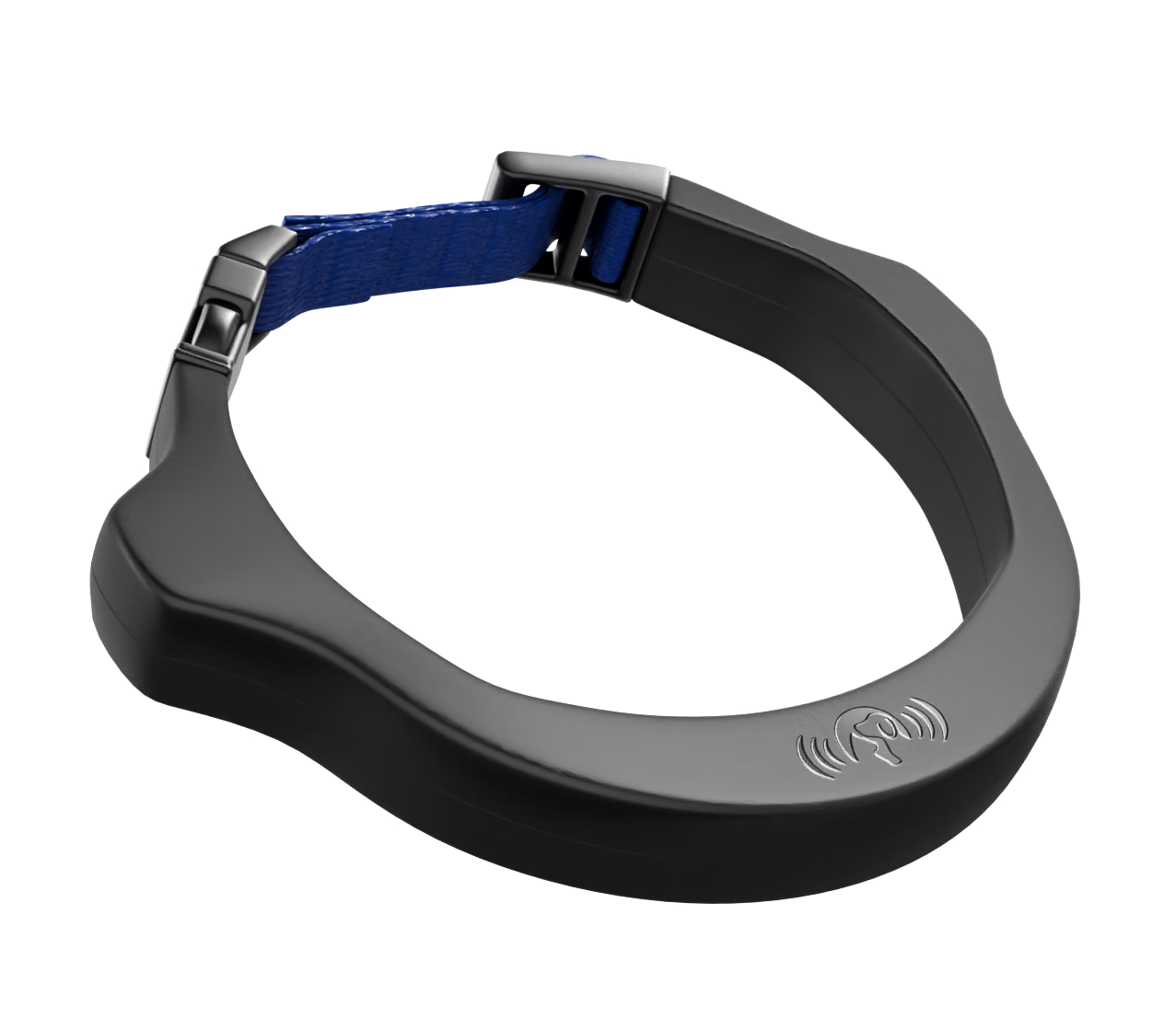
The search system for outdoor cats.
- Ultra-light collar made for outdoor cats
- GPS for the search area
- Radio for sheds, garages, cellars and dense cover
- Simple to use from the smartphone app
- 30-day money-back guarantee
Swiss Made · 30-day money-back guarantee
5. Dense bushes or a forest edge make visual search difficult
Outdoor cats love places that humans are bad at searching: hedges, wood piles, sheds, tall grass, narrow gaps and forest edges.
At that point, a map alone can feel like a promise that stops too early. You know the area, but you still do not know where to look next.
PetTracer helps turn that search into a more guided process.
6. GPS-only can be strong outdoors, but limited near buildings
GPS is extremely helpful for outdoor orientation. But cat recovery is not always a clean open-sky situation.
Walls, garages, basements, dense trees and narrow courtyards can make the final step harder. That is why the most important question is not only "Can I see a location?" It is "What happens once I get there?"
7. You do not want to learn how to search during the emergency
The worst time to compare trackers is the night your cat does not come home.
When you are worried, every minute feels longer. A search system is something you set up before you need it, like a seat belt or emergency tool. You hope it stays unused. But if the moment comes, it changes how prepared you feel.
Is PetTracer right for your cat?
PetTracer is especially relevant if your cat:
- Goes outside regularly.
- Has ever stayed away longer than expected.
- Lives near sheds, garages, gardens or forest edges.
- Is cautious, quiet or hard to find when hiding.
- Needs a system made for searching, not just checking a location.
FAQ
- Missing-cat study: https://pmc.ncbi.nlm.nih.gov/articles/PMC5789300/
- Apple AirTag product information: https://www.apple.com/airtag/
- PetTracer product page: https://pettracer.com/de-eu/products/pettracer-full-set